FILM
Spirits' Homecoming Returns to Theaters in an Extended Version 10 Years Later
Cho Jung-rae's film Spirits' Homecoming returns 10 years later in an extended version. The article summarizes its August 26, 2026 nationwide release, six minutes of added scenes, Tumblbug funding and plans for an official Japan release.
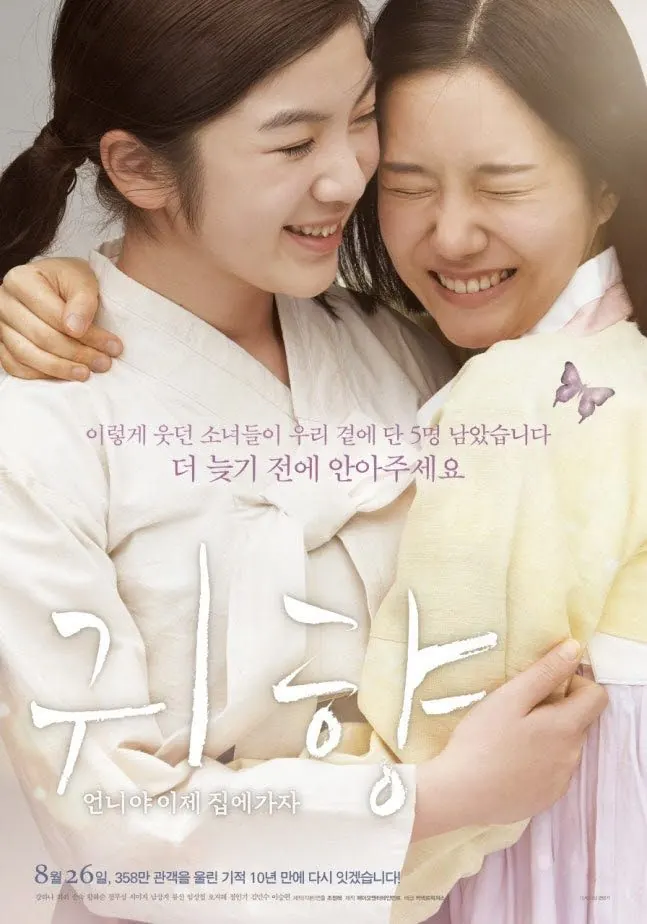
Cho Jung-rae's film Spirits' Homecoming will meet audiences again 10 years later in an extended version. According to distributor Connect Pictures and multiple reports, the film will open in theaters nationwide on August 26, 2026, Korea time, adding about six minutes of previously unreleased scenes and once again bringing attention to the memory of victims of Japan's wartime military sexual slavery system.
Spirits' Homecoming is returning to theaters. The Korean release title for this version is Gwihyang: Eonniya Ije Jibe Gaja, a subtitle that can be understood as "Sister, let's go home now." The film, first released in February 2016, drew 3.58 million viewers in Korea and is now returning as an extended version for its 10th anniversary. The key points commonly confirmed across reports are threefold: the nationwide opening date is August 26, 2026, Korea time; about six minutes of new footage has been added to the original film; and an official release in Japan is also being pursued.
The film was inspired by the painting Burning Maidens by the late Kang Il-chul, a victim of Japan's wartime military sexual slavery system. It centers on Jung-min, a 14-year-old girl taken by the Japanese military to an unfamiliar battlefield in 1943, and other girls of a similar age. The film also deals with the wounds that survivors had to carry in the years that followed. Director Cho Jung-rae began planning the project in 2002 but struggled to secure production funding. The film was eventually completed through support from 75,270 citizens and participation from actors and crew members.
Looking back at the first release of Spirits' Homecoming, it is difficult to describe the film as just one commercial movie. At the time, it addressed the issue of victims of Japan's wartime military sexual slavery system through the form of popular cinema, and its citizen-funded production process itself carried the character of social participation. The result of 3.58 million admissions also stood on that extension. More important than the box office figure was the fact that many viewers encountered survivors' memories again in theaters and that those memories moved into public discussion.
The extended version keeps the original story's main structure while adding new material. According to released descriptions, the added footage runs for about six minutes. The new scenes have been introduced as including stories of women in Korea, China and other Asian regions who experienced the same violence and harm. This change can be read as an attempt to widen the frame beyond the narrative of one country and toward the connected issues of war, colonial rule and women's human rights.
The running time has also changed. According to reports, the original 127-minute film has been expanded to 132 minutes. In simple numbers, that may not seem like a major difference. But in a film dealing with historical material, a few minutes of footage can shift the work's viewpoint and emphasis. That is why this extended version is being introduced together with the phrase "six minutes of truth."
Behind this re-release is also the reality that time is running out for surviving victims. According to SBS coverage, when Spirits' Homecoming was released in 2016, there were 47 registered survivors of Japan's wartime military sexual slavery system in Korea. After Kang Il-chul died in March 2026, Korea time, that number fell to five. Cho Jung-rae was reported as saying that Kang's death and Lee Yong-soo's request became reasons behind his decision to re-release the film.
This point makes the re-release look less like a simple return to theaters and more like a method of remembrance. As the time in which people can directly hear victims' testimonies becomes shorter, films and records become major routes for the next generation to encounter the events. Of course, a film is not historical material itself, but a creative work. That is why audiences also need to examine the facts, people and background events addressed by the film. The meaning of Spirits' Homecoming returning to theaters lies at that exact meeting point.
Movements ahead of the release are also continuing. The Tumblbug funding campaign related to Spirits' Homecoming runs until August 21, 2026, Korea time. The campaign has been introduced in connection with the meaning of August 14, Korea time, the memorial day tied to the late Kim Hak-sun's public testimony in 1991 about her experience as a victim. Supporters are offered benefits including name inclusion in the VOD end credits, invitations to nationwide screenings and official goods.
Some reports described the viewing movement around the film with a term close to "buycott." In general, a buycott refers to expressing one's position through belief-aligned consumption, in contrast to a boycott. In this case, the term has been used to describe audiences who are concerned about historical distortion and the fading of survivors' memories, and who express support through theater viewing and funding participation. Still, because the term can be interpreted broadly in terms of movement character and participation scale, the actual spread and audience response should be examined after release through objective figures and on-site reactions.
Cho Jung-rae is also preparing to meet audiences directly after the release. According to reports, beginning August 30, 2026, Korea time, he will tour five cities, including Seoul, Daejeon, Daegu, Busan and Gwangju, for special screenings. These events can be seen not simply as stage greetings, but as spaces where the director explains the historical background, production process and meaning of the extended version arriving 10 years later.
Developments in Japan are also drawing attention. According to SBS, the extended version was screened three times in Osaka, Japan, ahead of its Korean re-release, with about 200 Korean residents in Japan and Japanese viewers attending. Reports also said Cho and actor Kang Ha-na met local audiences and explained the film's background. The production team is also pursuing an official theatrical release in Japan. At the current stage, however, what has been confirmed is still at the level of pursuit and discussion.
The push for a Japan release carries symbolic weight. Spirits' Homecoming is known as a film that faced several difficulties during its Japan screening process 10 years ago. The fact that the extended version is discussing an official release with Japanese theaters shows that the film is not intended only for Korean audiences, but aims to share the memory of victims internationally. At the same time, how a film dealing with historical issues will be received in Japan may vary depending on local communities, theater conditions and audience groups.
The point to watch in Spirits' Homecoming is not only the amount of new footage, but how those scenes change the meaning of the original work. If the original film centered on one girl's suffering and longing to return home, the extended version is being introduced as placing the memories of multiple victimized women across Asia together. How that change expands the film's emotion and message will become clearer through audience responses after release.
This re-release is also a distinctive case within the film industry. Ordinary re-releases often proceed by allowing audiences to revisit memories of a hit film or by meeting new viewers through remastering. In the case of Spirits' Homecoming, remembrance, testimony, citizen funding and historical education are strongly intertwined. For that reason, this release should be viewed not only as a "10th-anniversary re-release," but also alongside the reality that the number of surviving victims has decreased over the past decade and the cultural role the film has taken on.
Summary Points
Spirits' Homecomingreturns in a 10th-anniversary extended version after drawing 3.58 million viewers with its 2016 release.- The film will open in theaters nationwide on August 26, 2026, Korea time.
- About six minutes of previously unreleased footage has been added, with the reported running time increasing from 127 minutes to 132 minutes.
- The film was inspired by
Burning Maidens, a painting by the late Kang Il-chul, a victim of Japan's wartime military sexual slavery system. - The Tumblbug funding campaign runs until August 21, 2026, Korea time, and director Cho Jung-rae is scheduled to begin special screenings in five cities on August 30, 2026, Korea time.
- Screenings have taken place in Osaka, Japan, and the production team is also pursuing an official release in Japan.