FILM
Last Summer Opens August 5, Bringing a Rural Time First Recognized by Film Festivals to Theaters
Choi Seung-woo's feature debut Last Summer opens in theaters nationwide on August 5. Filmed with real farmers in a rural village in Hongcheon, Gangwon Province, the film drew attention after winning awards at the Busan International Film Festival and Muju Film Festival.
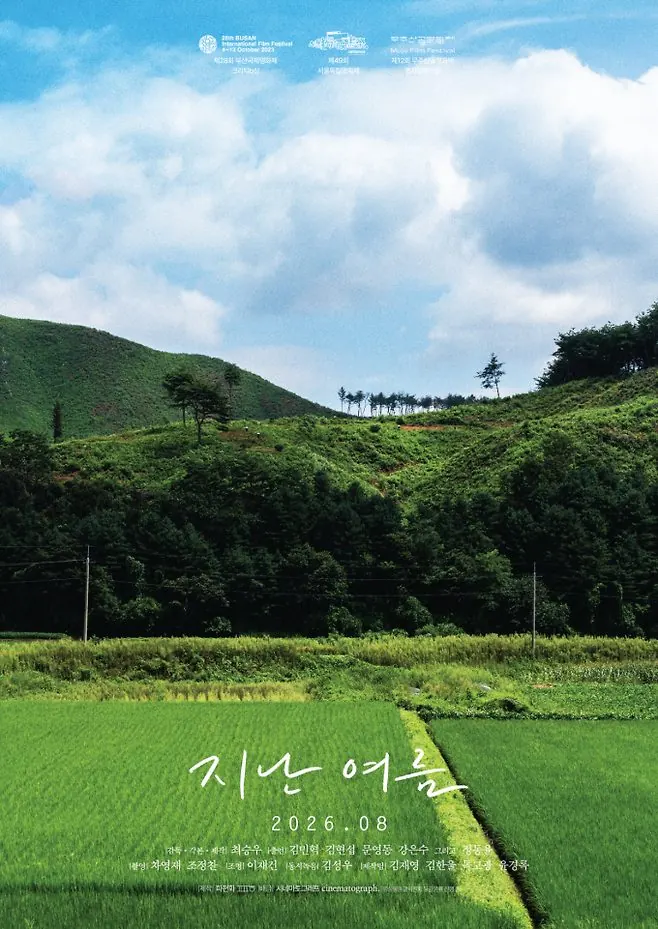
Choi Seung-woo's feature debut "Last Summer" opens in theaters nationwide on August 5, 2026 KST. Filmed with real farmers in a rural village in Hongcheon, Gangwon Province, the work first drew attention at the Busan International Film Festival and Muju Film Festival before meeting theater audiences.
The film "Last Summer" opens in theaters nationwide on August 5, 2026 KST. According to recent reports from several outlets, the work is the feature debut of director Choi Seung-woo and is a drama filmed with farmers in a rural village in Hongcheon, Gangwon Province. Because the film is moving toward official release after first meeting audiences and critics at film festivals, it is worth looking not only at the news of a new release, but also at the time the work has already passed through.
"Last Summer" is set in a farming village, but it does not use the countryside merely as background decoration. According to the released introduction, the film is structured in three chapters: "Drought," "Rainy Season" and "Harvest." It captures the changing landscape of nature according to the seasons and the daily lives of people who live in step with that flow. The characters in the film are not placed at the center of a huge event. Instead, they live through each day inside the changes of nature and the rhythm of labor. In that sense, the work seems closer to a film that follows time, bodily movement, weather and the sensations that seasons leave on people, rather than treating rural life only through dramatic conflict.
A line mentioned in reports offers a clue to the film's attitude: "People do 20 percent of the farming, and the sky does 80 percent." The sentence does not view agriculture simply as the result of labor. It reveals a life that cannot be completed only through human will and planning, and a time that must move with the flow of nature. The film's choice of chapters, "Drought," "Rainy Season" and "Harvest," connects with this line. The seasons of farming are not merely the background, but the structure of the story and the conditions that shake the characters' emotions and lives.
The place where the film first made its name was the festival circuit. "Last Summer" won the Critic b Award at the 2023 Busan International Film Festival and the Film Critics Award at the 2024 Muju Film Festival. These two awards are important context for understanding the work. The Busan International Film Festival has served as a window for discovering Korean independent films and feature works by new directors, while the Muju Film Festival is known to audiences as a festival emphasizing the relationship between nature and cinema. The fact that "Last Summer," a film about rural seasons and human time, drew attention at both festivals can be read as a result of the film's form and subject aligning with the nature of those festivals.
For Korean independent films, the path from festival recognition to theatrical release is not always easy. Even a work that receives favorable reviews at festivals needs time to secure screening opportunities and points of contact with audiences. "Last Summer" also took a certain amount of time from festival unveiling to theatrical release. That time is part of the process in which the way the film meets audiences shifts from festival screenings to theater screenings. At festivals, the work first meets viewers who actively seek it out, while theatrical release is the stage where it can be exposed to a wider audience.
The Cine21 critic responses released ahead of the opening have also added attention to the film. According to several articles, critics focused on the film's attitude toward nature and people, its way of capturing the cycle of the seasons, and the texture created together with an actual rural community. Rather than quoting any critic's words at length, the overall direction of the responses suggests that "Last Summer" is being received not as a film built around large events, but as one that patiently watches sensations of time and labor that can easily disappear.
What matters in this film is that it was "filmed with real farmers." How the boundaries between actors and non-actors, and between documentary and fiction film, are coordinated within the work must be confirmed through viewing, but even the information released so far suggests the film's production attitude. Rather than reproducing the countryside through an outsider's gaze, it appears to emphasize close observation of the gestures, speech and rhythms of life of the people who live in that place. This also connects with an attitude that does not try to romanticize the countryside or consume it simply as a space of nostalgia.
The poster image also shows this direction. The previously released "sunrise" poster captured the moment when a village day begins. The sun rising beyond the mountains, the orange sky and the image of fields holding sunlight convey the expression of nature that the film observes. The main poster released later shows green summer paddies, a wide sky and mountain scenery. Reports also described it as having a bright and clear atmosphere different from the earlier "rainy season" poster. The fact that the posters each show different senses of season and weather also connects with the film's chapter structure.
Films about rural areas are sometimes grouped simply as slow cinema. But "slowness" alone is not enough to explain this work. The time of farming is not merely slow. It is repetitive, demanding, sensitive to weather and open to unpredictable change. Drought creates waiting, the rainy season shakes plans, and harvest carries one season's labor into another time. The film following seasonal changes through three chapters means that this agricultural temporality is placed at the center of the story.
"Last Summer" has been introduced with a running time of 76 minutes. That is relatively short for a feature film, but it does not mean the time handled by the work is brief. Instead, it appears closer to compressing the feeling of a season and the rhythm of a community into a limited running time. Reports that mention critics' references to the cycle of time and life also connect with this point. When audiences watch this film, what may matter is not the scale of events, but how time passes inside the frame and how the characters are placed in that flow.
The fact that this is Choi Seung-woo's feature debut is also worth noting. A feature debut is a place where a director's first feature-length cinematic attitude is revealed. The object a director chooses, the pace at which it is observed, and the distance set between people and space all shape the impression of the work as a whole. Rather than foregrounding urban incidents or genre devices, "Last Summer" chose the rural landscape of Hongcheon, Gangwon Province, and the lives of actual farmers. This choice shows what kind of world the director wanted to observe patiently in his first feature.
In Korean independent cinema, rural spaces have often been drawn as places that are disappearing. They are far from the speed of the city and the center of media attention. But the countryside is not simply a place of the past. It is a present-day space where climate, labor, community, generations and regional change appear together. The fact that "Last Summer" uses a rural setting is also a choice that asks viewers to reconsider the relationship between nature and people, while bringing a rhythm of life not often seen in Korean society onto the screen.
The attention around this film is focused more on its perspective than on exaggerated box office expectations. Festival awards can serve as grounds for explaining the film's quality, but theater audience response is something that will be confirmed after release. Cine21 critic ratings and festival evaluations can provide a good starting point, but how audiences receive the film in theaters is a separate matter. The audience for independent films changes depending on subject matter, screening environment, word of mouth and access to theaters.
Even so, the release of "Last Summer" is a meaningful schedule. It is the process of a film first discovered at festivals meeting general audiences through theaters. The village in Hongcheon, Gangwon Province, the time of real farmers, the three seasonal chapters, the light of summer, the dampness of the rainy season and the labor of harvest will have to be confirmed in the theater as they connect within one film. The question the work asks may not be grand. Instead, it seems closer to quietly asking how people live, what they rely on to pass each day, and what attitude humans come to hold before the changes of nature.
"Last Summer" opens in theaters nationwide on August 5, 2026 KST. The key information confirmed so far is that it is Choi Seung-woo's feature debut, that it was filmed with real farmers in a rural village in Hongcheon, Gangwon Province, that it is structured around the three chapters "Drought," "Rainy Season" and "Harvest," and that it won awards at the Busan International Film Festival and Muju Film Festival. After release, attention is expected to turn to how festival evaluations connect with theater audiences.
Summary Points
- "Last Summer" is Choi Seung-woo's feature debut and opens in theaters nationwide on August 5, 2026 KST.
- The work is a drama filmed with real farmers in a rural village in Hongcheon, Gangwon Province.
- The film follows the seasons and the lives of farmers through three chapters: "Drought," "Rainy Season" and "Harvest."
- It won the Critic b Award at the 2023 Busan International Film Festival and the Film Critics Award at the 2024 Muju Film Festival.
- The released posters and Cine21 critic responses point to the film's key emotions: nature, time, labor and the cycle of life.