FILM
The Assassin(s) Passes 1 Million Admissions on Day 4: What Put It Atop the Chuseok Box Office
Hur Jin-ho's film The Assassin(s) reached 1,057,760 cumulative admissions on its fourth day in theaters. Here is a look at its box office momentum, including 420,000 admissions on Chuseok, and the modern-history mystery led by Yoo Hae-jin, Park Hae-il, Lee Min-ho and Park Jeong-min.
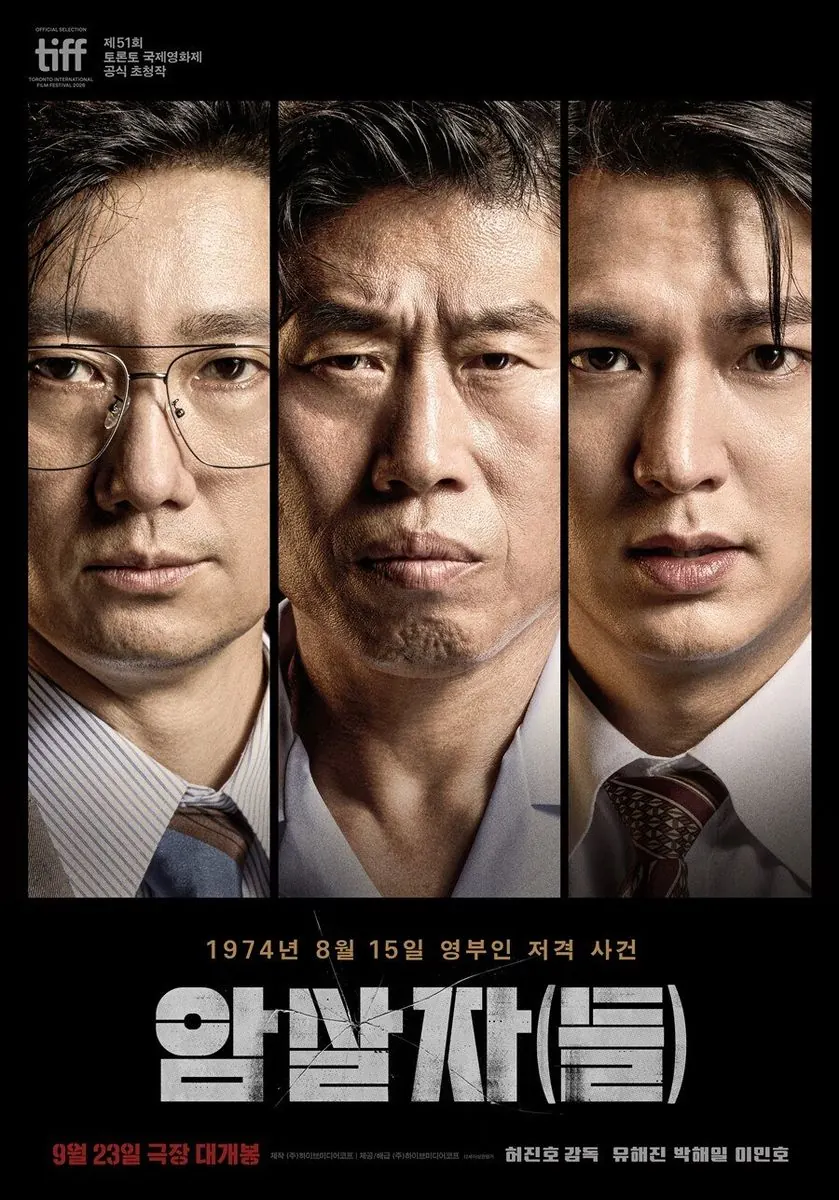
Director Hur Jin-ho's film The Assassin(s) surpassed 1 million cumulative admissions on its fourth day in theaters. The milestone came after the film drew more than 420,000 moviegoers on Chuseok and retained the top spot at the box office. The holiday boost and wide availability of screenings contributed to the rapid increase, but audiences also responded to its mystery-driven reconstruction of a real event in modern Korean history and the ensemble cast at its center.
The Assassin(s) has become the first film of the 2026 Chuseok season to pass 1 million admissions. According to combined data released by the Korean Film Council's integrated box office system and distributor Hive Media Corp, the film had recorded 1,057,760 cumulative admissions as of 7 a.m. on September 26, 2026 KST. It reached the mark four days after opening on September 23, 2026 KST.
Daily attendance accelerated as the holiday began. The film drew 288,485 admissions on September 24, 2026 KST, the first day of the Chuseok holiday, followed by 426,260 on Chuseok itself, September 25 KST. Multiple reports also confirm that it remained No. 1 at the overall box office for the first three days after its release. Because figures recorded at a particular time may later be updated, the cumulative total of 1,057,760 should be understood as the count reported at 7 a.m. on September 26 KST.
The 1 million figure is an important indicator of the film's early box office performance. The Assassin(s) entered its opening stretch during the Chuseok holiday rather than a regular weekday period, giving audiences comparatively more time to visit theaters. The number of screenings, seat availability and placement of competing titles also affect admissions. Passing 1 million on day four therefore demonstrates the speed of the film's start, but its final result will depend on audience retention after the holiday, word of mouth and screening conditions. Some reports compared the pace at which the film reached 1 million with 12.12: The Day and The Odyssey. Reaching the mark within a similar period offers one point of reference for understanding how quickly audiences responded.

A commemorative image marking 1 million admissions for The Assassin(s). Photo=Hive Media Corp
The Assassin(s) is a crime drama inspired by the shooting of South Korea's first lady on August 15, 1974 KST. The official synopsis describes a story that traces the questions and forces behind the case. Although it begins with a real event, it is important to note that the film is not a documentary reconstructing the historical record in chronological order. It is a fictional feature that adds invented characters and cinematic imagination. Because familiar historical facts and a fictional investigative narrative appear side by side, viewers should distinguish the film's interpretation from the established historical record.
The story follows three perspectives: Cheolgu, the detective assigned to security at the scene; Jaehwan, the head of a newspaper's social affairs desk; and Yeongil, a rookie reporter who witnesses the confusion surrounding the incident. Yoo Hae-jin plays Cheolgu, Park Hae-il plays Jaehwan and Lee Min-ho plays Yeongil. From different positions, the three characters examine the gap between the official account and what occurred at the scene, following the circumstances each has uncovered. By dividing the narrative among law enforcement, the press and an eyewitness, the film avoids reducing the event to a single point of view.
Yoo Hae-jin's Cheolgu is positioned close to both the scene and the inner workings of the investigation. His role as the detective responsible for security gives him both a sense of responsibility for failing to prevent the incident and doubts about the investigation's findings. Park Hae-il's Jaehwan guides the reporting as the head of a newspaper's social affairs desk. His story forms an axis showing how information gathered in the field becomes a published article, as well as the tension between power and the press.
Lee Min-ho's Yeongil is introduced as a rookie reporter in the social affairs department at Dongseong Ilbo. He witnesses the shooting while reporting and pursues the difference between what he saw and the account that becomes official. His inexperience gives audiences an entry point into the case. By placing a character who keeps asking questions at the forefront instead of one accustomed to the existing order, the film presents the historical incident not as a settled episode from the past, but as something to examine again.
Park Jeong-min plays Moon Tae-gwang, a fictional character inspired by the real-life Moon Se-gwang. Moon Se-gwang was a young Korean resident of Japan who is known to have opened fire at then-President Park Chung-hee during the 1974 Liberation Day ceremony; First Lady Yuk Young-soo was killed in the incident. The film changes his name to Moon Tae-gwang and adds fictional elements. It would therefore be inappropriate to assume that Moon Tae-gwang's actions, motives and relationships correspond exactly to the historical record concerning Moon Se-gwang.
The real case resulted in legal judgments after an investigation and trial, but debate continued over the sequence of events, the security response and the trajectory of the bullets. The plural form in the title The Assassin(s) uses those lingering questions as the starting point for its mystery. The questions raised by the film, however, also serve as devices for constructing its narrative. Even if the film presents a particular theory, that does not make it a newly established historical fact or an official investigative finding.
The track record of Hive Media Corp, which produced and distributed the film, also provides context. The company has produced films including The Man Standing Next and 12.12: The Day, both of which translated political events from modern Korean history into the language of commercial cinema. The Assassin(s) follows that current by combining the weight of a real event with genre tension and an actor-driven narrative. Turning an event from an earlier era into a story accessible to contemporary audiences can broaden a film's commercial prospects, but it also carries a responsibility to state clearly where fact ends and fiction begins.
Its appearance at an international film festival before the domestic release also raised interest. The Assassin(s) was invited to the Gala Presentations section of the 51st Toronto International Film Festival. Hur Jin-ho, Yoo Hae-jin, Park Hae-il and Lee Min-ho attended events there, and the official screening introduced the film to an international audience. A festival invitation does not guarantee domestic box office success, but it gave the film visibility before release and provided an opportunity to present the work of its director and cast.
The cast also helps the film reach audiences across generations and regions. Yoo Hae-jin and Park Hae-il have portrayed a wide range of characters over long film careers, while Lee Min-ho has built an international fan base through television dramas and global streaming productions. Reports also noted that Lee ranked first in the most favored Korean actor category for a 13th consecutive year in the 2026 Overseas Hallyu Survey released by the Ministry of Culture, Sports and Tourism and the Korean Foundation for International Cultural Exchange.
The fact that a modern-history mystery running roughly 130 minutes attracted moviegoers also carries significance for the Korean film industry. The theatrical market has recently faced rising production costs, declining attendance and competition from streaming services. A weighty genre film based on a historical event, rather than only familiar intellectual property or light entertainment, becoming an early holiday choice suggests that audience demand is not converging on a single genre.
The early success of The Assassin(s) reflects the combined effects of the holiday, screening conditions, the cast's recognition and interest in its modern-history subject matter. The more important question is what a film based on a real event leaves audiences asking and whether those questions lead to further conversation about the work. When the distance between cinematic imagination and historical fact remains visible, the 1 million figure becomes more than a box office record: it can also offer a measure of how contemporary audiences consume and interpret the past.
Summary Points
The Assassin(s)recorded 1,057,760 cumulative admissions as of 7 a.m. on September 26, 2026 KST, passing 1 million on its fourth day in theaters.- Directed by Hur Jin-ho, the crime drama is inspired by the shooting of South Korea's first lady on August 15, 1974 KST.
- Yoo Hae-jin plays detective Cheolgu, Park Hae-il plays social affairs desk chief Jaehwan, Lee Min-ho plays rookie reporter Yeongil, and Park Jeong-min plays Moon Tae-gwang, a character inspired by Moon Se-gwang.
- Because the characters and investigation of forces behind the case belong to a fictional feature narrative, the film's interpretation should be distinguished from the established historical record.